
Last Updated on 5 mins by Publishing Team

| Transmission Update:
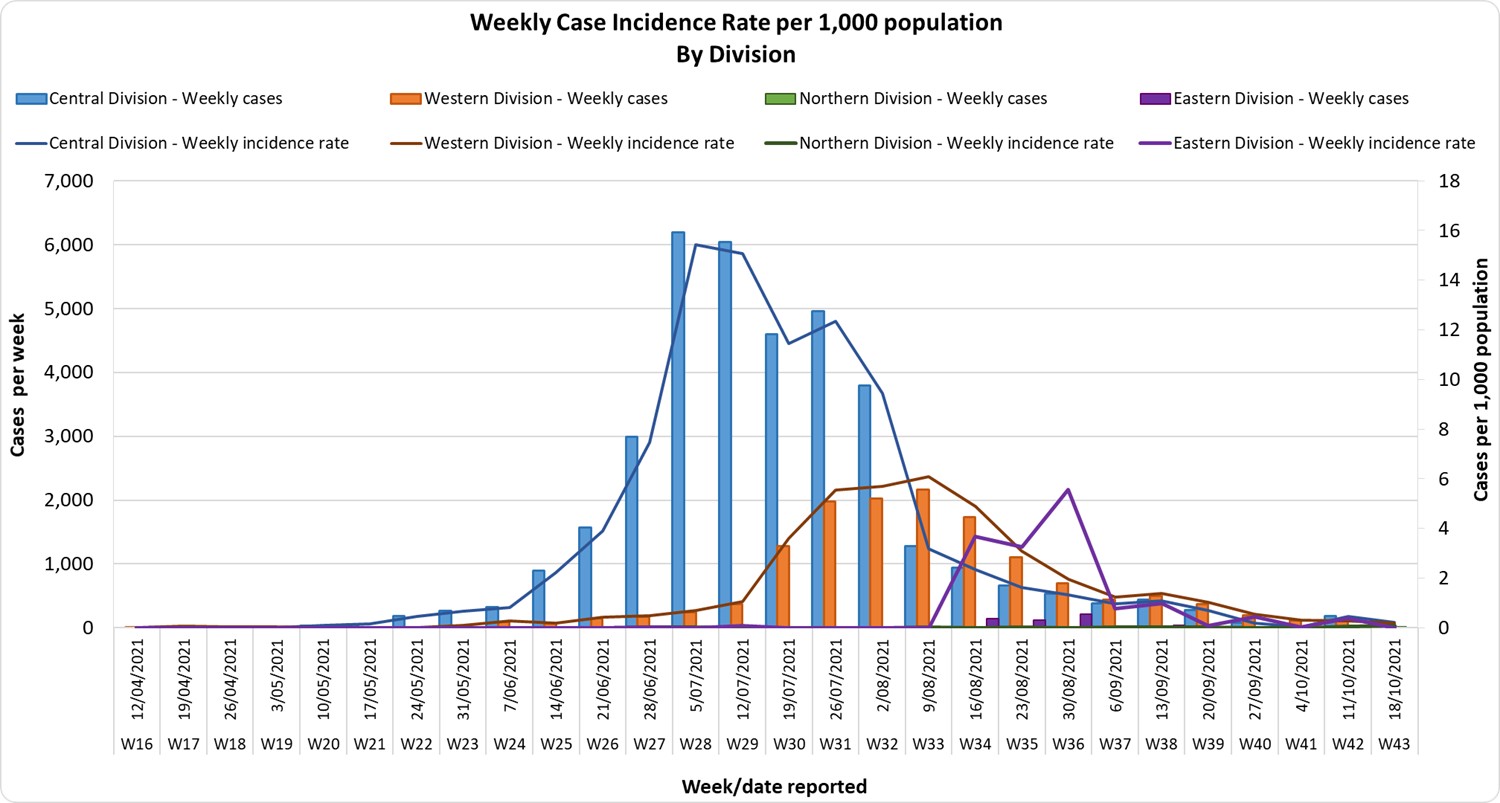
The central division cases constitute 71% of the cumulative total cases nationally, with the western division making up 28% and 1% in the northern and eastern divisions. The 13 new cases recorded in the north are quarantine cases that are part of the repatriation program for the northern division. There is ongoing surveillance conducted for all repatriates. Since the last update, we have recorded 50 new cases of which 35 new cases were recorded on 26/10/2021 and 15 new cases in the last 24 hours ending at 8 am this morning. The weekly incidence rate graph by division indicates a continually declining trend. Furthermore, the peak weekly incidence in the western division was approximately a third of that in the central division, and the cumulative case numbers are also reflecting a similar difference. |
| Deaths:
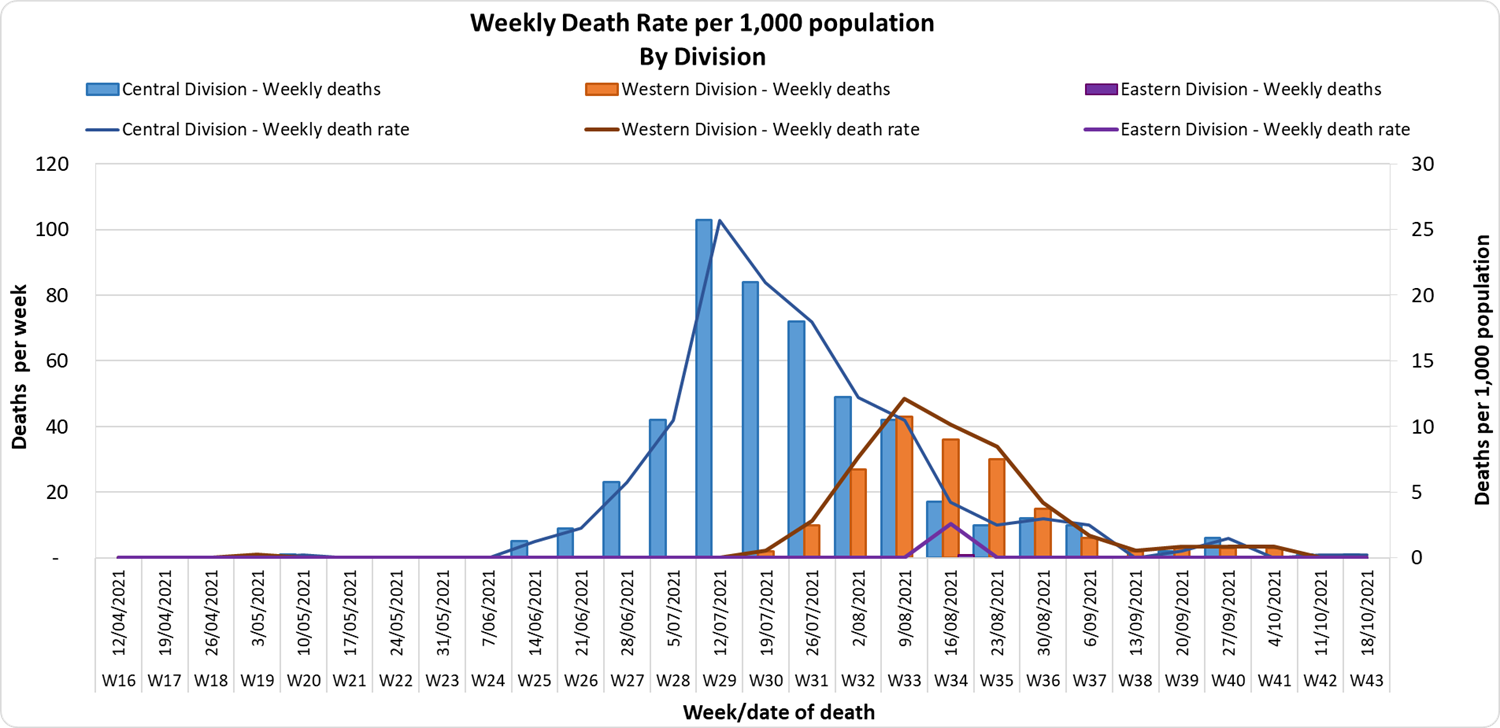
This curve depicts the weekly death rate per 1000 population by divisions since the 2nd wave of this outbreak began in April 2021. Overall the death rate graphs for the Central and Western Divisions indicate a declining trend. The differences between the Central and Western are similar to the incidence of the weekly cases and are likely a reflection of vaccination levels, COVID mitigation measures, and differences in population density. There is no COVID-19 death to report for today. There have been 673 deaths due to COVID-19 in Fiji, with 671 of these deaths during the outbreak that started in April this year. Please note that due to the time required by clinical teams to investigate, classify and report deaths, a 4-day interval is given to calculate the 7 days rolling average of deaths, based on the date of death, to help ensure the data collected is complete before the average is reported. Therefore, as of October 23rd, the national 7 days rolling average of COVID-19 deaths per day is 0.1. The 7 days rolling average for COVID-19 deaths per day in the Central Division is 0.1 and 0.0 in the Western Division, with a case fatality rate of 1.29%. |
| Hospitalisation:
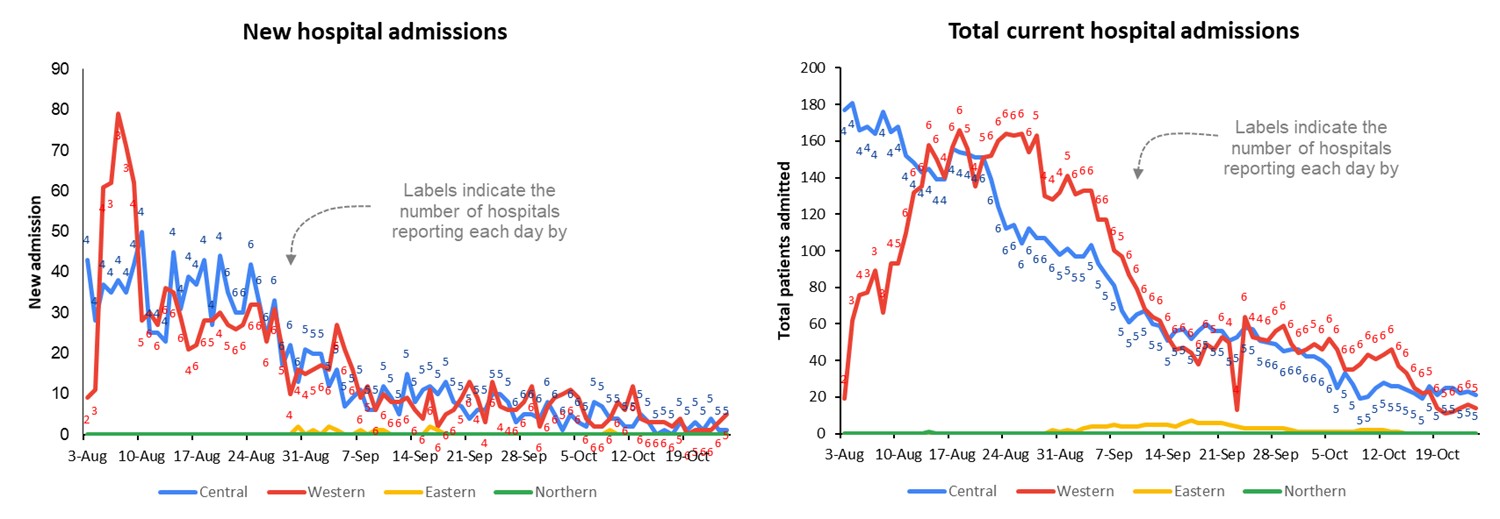
The downward trend in both the new hospital admissions and total admissions in all hospitals admitting COVID-19 patients across the country is consistent with the cases and death trends. The hospital admissions continue on a downward trend indicating a sustained positive response to COVID mitigation measures, Population density differences, and differential Vaccination rates. |
| Testing:
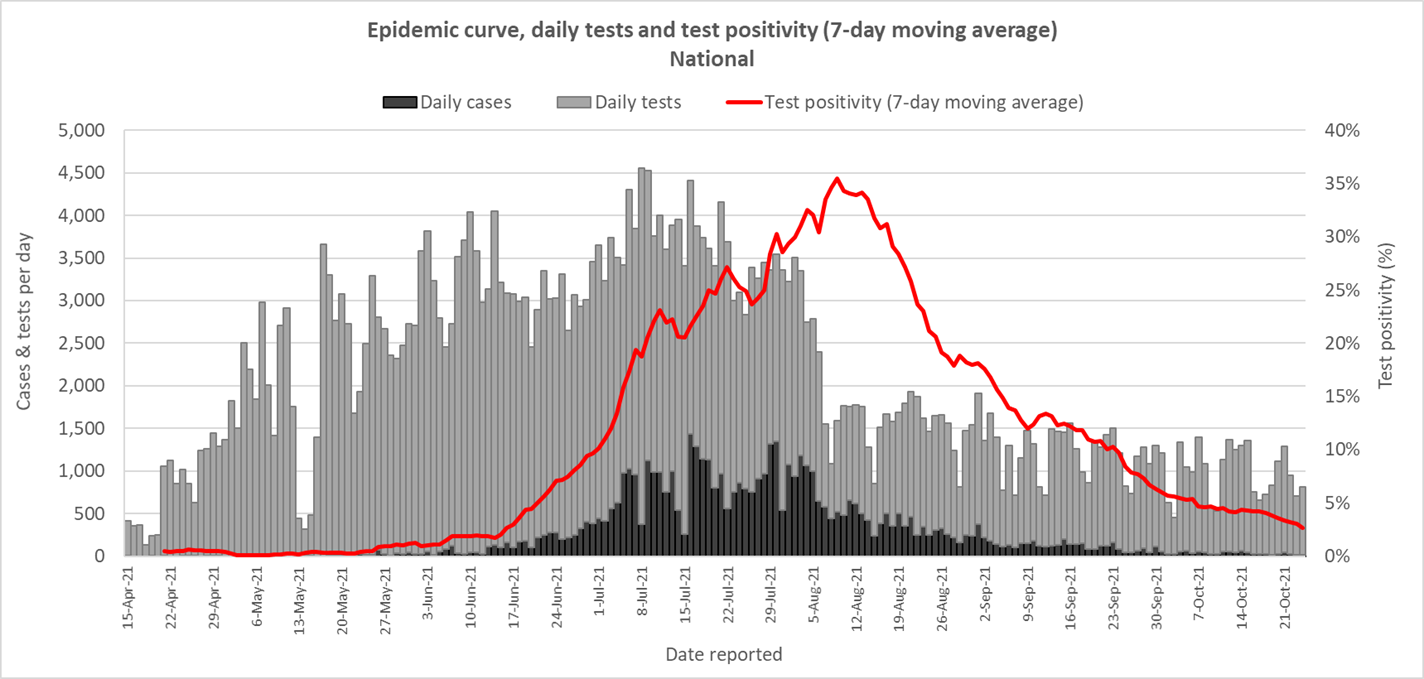
1,318 tests have been reported for October 19th, 2021. The 7-day daily test average is 1,028 tests per day or 1.2 tests per 1,000 population. The national 7-day average daily test positivity is 2.3%, which is on a downward trend, and below the WHO recommendation of 5%, and this is illustrated by the lab testing graph; also noting the reduction in the daily number of cases. Though we continue testing in high-risk areas, our case numbers and test positivity rate continue to decrease, indicating a better control of the community transmission in Fiji through the combined efforts of containment and mitigation measures with ongoing community surveillance. |
Epidemic Outlook:
The 7-day average of new cases per day is 24 cases per day or 27 cases per million population per day. As previously announced by the Permanent Secretary, the daily case numbers are currently not being used as the sole indicator to monitor the progress of the outbreak. The Ministry continues monitoring other indicators such as test positivity, hospitalisations, and deaths to track the progress of the outbreak, and it is noted that there is a downward trend across all indicators of the COVID-19 epidemic in Fiji.
With the reduction in testing numbers, which is above the WHO recommended rate of 4 tests per 1,000 population per week (or approx. 3,500 tests per week), we will transition to community surveillance testing as severe disease numbers and positivity rates approach the containment phase levels.
The overall indications of the cases, hospitalization, and deaths data indicate a positive response to our overall COVID response with the epidemic in the west having a lower and delayed disease peak with lower cumulative numbers compared to the Central Division.
Public Advisory:
Repatriation Program to the North
The vaccination coverage for the North is more than 90% for the first dose and more than 75% for the second dose. We are currently reconciling this data with repatriating Northerners who received vaccines on Viti Levu however we remain on track to get beyond 80% before the 11th of November. As reported on Monday, the second dose vaccination coverage for the Bua sub-division remains a concern based on the MOH vaccination coverage data
Over the 7-day period from 20/10/21 to 26/10/21, we have recorded 60 quarantine test results of concern from around 700 travelers to the North. All the 60 persons were fully vaccinated and had tested negative prior to travel to the North.
From this 60, 10 cases are potentially infectious and are being isolated. Also, home quarantine measures have been activated for their primary contacts. A further 31 cases are considered non-infectious or at very low risk of being infectious. A further 19 cases were weakly positive however we await repeat test results from the Fiji CDC laboratory while they remain under home quarantine.
The Northern Medical Team is working with the Commissioner Northern Division team and Ministry of Economy on ration supply for cases and family members on restricted movement protocol.
The Minister will be leading a team to go to the North together with the Community Engagement team from various ministries, on Tuesday 2nd of November to help to escalate our 2nd dose coverage, especially in Bua. This will include a special dispensation to reduce vaccination interval to 6 weeks for AstraZeneca. Furthermore, all clinical support measures to mitigate the increase in COVID 19 cases and cases with severe COVID-19 have been set up with emphasis on Nabouwalu and Labasa Hospitals.
Exemption from Vaccination
We have received a number of requests for exemption from vaccination on medical grounds. The exemptions on medical grounds are provided for the following reasons:
- Documented history of severe allergic reaction to a component of each currently available COVID-19 vaccine;
- Documented history of severe or immediate-type hypersensitivity allergic reaction to a COVID-19 vaccine, and separate contraindication to other available formulations;
- Receiving immunosuppressive treatment(treatment that weakens the body’s immune system) and advised by a medical provider to defer vaccination to a future date;
- For those with a medical condition, please be advised that in most cases vaccination is even more indicated. While an opinion by a medical provider to forgo vaccination or to defer vaccination will be considered, this requires that the application is accompanied by documentation to prove that the person has the medical condition as stated. Furthermore, the final decision on exemption will be based on consensus guidelines from the Strategic Advisory Group of Experts on Immunization (‘SAGE’) and similar international authoritative bodies.
The following conditions that are NOT considered for a medical exemption include:
- History of severe allergic reactions to foods, oral medications, latex, pets, insects, and environmental triggers;
- History of immunocompromising conditions where the vaccine may be less effective;
- Fear of needles;
- A history of vaccine side effects or general avoidance of vaccines.
International Travel
From 11th November through to 1st December 2021, Fiji will only accept fully vaccinated permit holders, Fijian passport holders, and returning residents who will be required to undertake a 3-day quarantine in a Fiji Managed Quarantine facility and will be subject to RT-PCR tests 72 hours pre-departure and in-country. Beginning 1st December 2021, Fiji will be open to fully vaccinated travelers from Travel Partner Countries for reduced quarantine arrangements on arrival.
The Ministry of Health and Medical Services is also in the final phases of:
- Re-escalating our community surveillance back to containment phase levels with a strong emphasis on our careFIJI to facilitate tracking and rapid contact tracing efforts;
- Strengthening our line listing for positive cases and vulnerable persons;
- Ensuring better access to Clinical monitoring and outreach capability and retrieval services for those in the line list;
- Strengthening our Clinical Care Protocols
The public is reminded that there will always be people vulnerable to the virus despite our high vaccination coverage. We have one-third of the population under 18 years old, most of whom still need to be vaccinated. We will have older people with comorbidities whose ability to build up vaccine immunity is not as good as younger and healthier persons. Also of concern is that we will have unvaccinated people in our communities who are also not exposed to the virus, and hence do not have any protection against the disease, and among them are elderly persons and those with serious comorbidities. As such, future resurgence of infections and increased case numbers will again test our critical care capacities. We are constantly reviewing and updating our healthcare protocols so we can respond effectively to future outbreaks.
The key to avoiding future restrictions and lockdowns is for the public to remain cautious about how they engage in the greater freedom they will enjoy. Whilst the easing of restrictions is needed to facilitate social and economic livelihood, the public must ensure that together with vaccination, we continue to observe our COVID safe measures and avoid contained spaces and crowds.
The potential for transmission in any community will be slower, and the ability to contain the outbreak better, when we achieve a high vaccination rate and also maintain strict adherence to COVID safe measures. When we do this, we not only protect ourselves but also protect all those around us, especially the vulnerable, those not eligible for vaccination, and those who are not yet vaccinated.